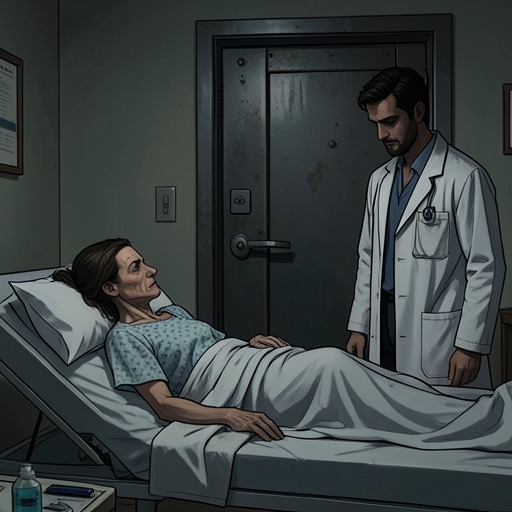
Kate Ryan's Terminal Prognosis
Firefly LaneKate Ryan's terminal prognosis is the moment when a cancer diagnosis becomes an explicit announcement of imminent death: her inflammatory breast cancer has metastasized to her brain, and treatment has failed. The revelation forces Tully Hart to confront both the finality of Kate's illness and the months of estrangement that kept her from standing beside her friend during treatment. Kate, meanwhile, refuses to let the remaining time be organized around a last, futile attempt to save her; she asks Tully to be with her.
Warning Signs and Diagnosis
The crisis is foreshadowed by a breast examination that breaks through the routine of ordinary medical conversation. During a checkup, Dr. Marcia Silver notices a quarter-sized red patch beneath Kate's right nipple, with skin puckered like an orange peel. Kate says it has been there for nine months, perhaps a year. What began, in her account, as something like a bug bite had been treated as an infection with antibiotics; it seemed to go away, then returned, sometimes feeling hot. She also points out that her mammogram had been clear.
Dr. Silver stops making small talk and immediately calls to arrange a breast ultrasound. Her urgency contrasts with Kate's prior understanding of the recurring patch as an infection and with the reassuring mammogram. The scene does not yet name the eventual prognosis, but it shows how a familiar explanation can fail to account for a persistent bodily change—and how the next step comes from a clinician recognizing that the symptom warrants further investigation.
When Kate later prepares to tell Johnny, she turns the disclosure into a deliberate act. She dresses in a pink cashmere V-neck sweater, a Christmas present from the children, and worn Levi's, brushes her hair into a ponytail, and puts on makeup because she wants to look healthy for what is coming. Johnny rises from the end of the bed, trying to be strong as his eyes fill. Rather than allowing his fear to make her falter, Kate draws strength from the visible evidence of his love and tells him she has cancer.
The Prognosis Reaches Tully
Tully learns the full extent of Kate's illness from Johnny, not from Kate. When Johnny says the cancer is inflammatory breast cancer, Tully reaches for a familiar sequence of treatment—mastectomy, radiation, chemotherapy—and says she knows people who have fought it. Johnny answers that Kate has already had all of those treatments. The difference between Tully's imagined beginning of treatment and Kate's reality exposes how much has happened outside Tully's knowledge.
Johnny explains that Kate called Tully several months earlier because she wanted her at the hospital. Tully did not return the call. His voice takes on an edge as he reminds her of the unanswered request, and Tully is overwhelmed by guilt at the time lost. Mrs. Mularkey cuts through that self-reproach by saying none of it matters now. The exchange makes the estrangement part of the prognosis's emotional force: Tully is not simply hearing that Kate is dying, but discovering that she missed the period when Kate had hoped to have her beside her.
Johnny then describes the latest turn. The cancer has metastasized; after Kate suffered a minor stroke the previous night, doctors took her to the operating room quickly, but once inside they saw nothing could be done. His voice breaks. Mrs. Mularkey puts a hand on his and states that the cancer is in Kate's brain. She then says plainly that Kate is dying. The account moves from disease name, to treatment history, to failed intervention, and finally to the prognosis itself, leaving no room for Tully's assumption that another standard course of treatment is still ahead.
A Different Meaning of Hope
When Tully faces Kate, she initially responds to the prognosis by proposing another intervention: she remembers a doctor in Ontario doing promising work with a new drug and offers to call him. Kate says she is finished with treatments. She has had them all, and none has worked; what she wants now is for Tully to be with her. The exchange turns on a conflict between Tully's impulse to act and Kate's knowledge of the course she has already endured.
Tully recoils from what she hears, naming the prospect as watching her friend die and refusing to accept it. Kate answers with a small smile that this is all there is. She reminds Tully that Johnny did not simply give up: for six months, she saw specialist after specialist and tried conventional, unconventional, and naturopathic remedies. The evidence of that sustained search changes what the choice to stop means. It is not presented as a refusal to fight from the outset, but as Kate's decision after extensive treatment has failed and after she has reached her limit.
The scene therefore shifts the meaning of hope from another cure to time spent together. Tully's instinct is to search for the exception, while Kate asks for presence rather than another plan. Her request sets a practical and emotional course for what remains: the prognosis cannot be reversed by Tully's determination, but friendship can still shape Kate's last days.
The Body's Decline and the Work of Care
As the weeks pass, Kate's decline becomes concrete in small losses of capacity. She cannot find a word or finish a sentence; her fingers tremble, nausea becomes unbearable, and she is persistently cold. The progression is not confined to the stark declaration that the cancer is terminal. It reaches into speech, movement, comfort, and the ordinary experience of her body.
By late July, pain has led Kate to nearly double her morphine dosage. The narrative places that increase within hospice care rather than framing it as a moral failure: her doctor tells her that addiction is not her problem now. The contrast between a dosage once governed by concerns about dependence and the immediate reality of severe pain underscores how the priorities of care change as the illness advances. Kate's prognosis thus carries consequences not only for what treatment is no longer possible, but for what comfort requires.
The people around Kate respond through acts of practical presence. When Tully announces that she is leaving her television show to be with her family, she makes the choice visible by removing her microphone and walking offstage. On Kate's last night in the hospital, she persuades Johnny to take the children home and takes his place in the other bed. She pushes it across the linoleum until it nearly touches Kate's, then plays a tape of her final show. They watch together like eighth-grade girls at a sleepover. The gesture does not deny the prognosis; it gives their friendship an ordinary, shared shape inside it.
Significance
The prognosis brings Tully's history of loss into sharp focus. Earlier, after Ima dies, Tully tells Kate that Gran has died and receives the compassion she has been waiting for; Kate holds her while she sobs. When Tully later faces Kate's terminal illness, she again encounters the fear of losing a person who has made herself a source of safety. Yet this time the loss is not retrospective: Kate is still present, able to tell Tully what she needs, and Tully can answer that need with companionship.
That distinction gives the event its emotional and narrative weight. Tully cannot repair the months in which she failed to return Kate's call, and she cannot turn treatment into a cure by will. She can, however, return to Kate's bedside. The prognosis marks the end of the story's expectation that effort might save Kate, but not the end of what the two friends can still do for one another: sit close, watch a tape, and meet the time left without disguising what it means.